Multi-zone Temperature Control Technology of Vertical Tube Furnace in Material Synthesis
1. Multi-zone Temperature Control: Core Upgrade of Vertical Tube Furnace
The multi-zone temperature control technology of vertical tube furnace is a core technical upgrade developed to solve the inherent defects of traditional vertical furnaces, such as fast heat dissipation at the upper and lower ends and large axial temperature difference. It is also the key to adapting the equipment to complex material synthesis processes.
Traditional single-zone vertical furnaces can only achieve a single constant temperature section, with a uniform temperature zone accounting for only 10% to 15% of the total, which is difficult to meet the needs of refined material preparation. The multi-zone temperature control technology completely makes up for this shortcoming.
This technology enables flexible regulation of the entire temperature field inside the furnace. It can not only effectively extend the length of the uniform temperature zone, but also customize special temperature distributions such as gradients and steps according to process requirements. It has become a standard function of high-end scientific research and mass-produced vertical tube furnaces.
The core principle of this technology is divided into three parts: zoned independent temperature control, uniform temperature field regulation, and atmosphere-temperature coordinated control. Each zone is equipped with independent heating elements and sensors, with a temperature control accuracy of ±1℃, and the temperature difference between adjacent zones is controlled within 5℃, ensuring stable and precise temperature control.
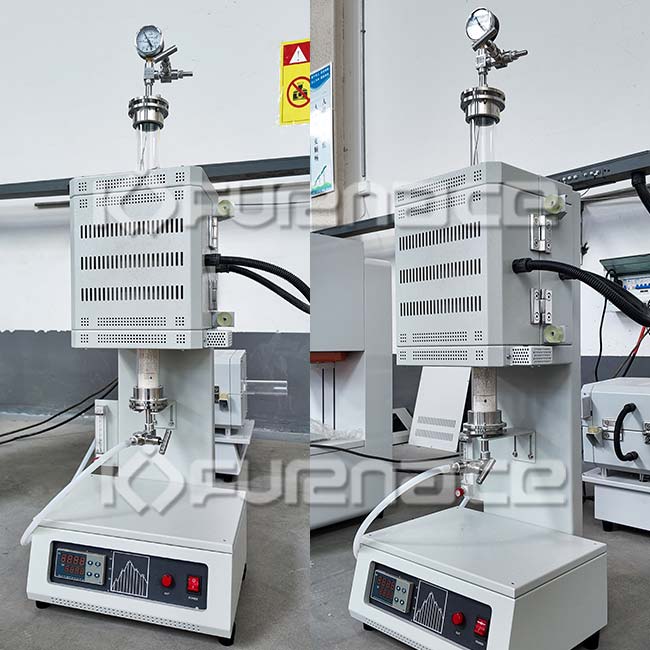
Relying on its unique structure and temperature control design, the vertical multi-zone tube furnace has significant advantages in space efficiency and production capacity. The equipment is compact, with a 1.2-meter-high model covering only 0.5 square meters, saving 60% space compared with horizontal furnaces of the same volume.
It can realize 2-4 station parallel heating by stacking furnace bodies, increasing production capacity by 30%-50%. The vertical feeding design is also convenient for automatic loading and unloading, perfectly adapting to both scientific research and continuous mass production scenarios.
In terms of process flexibility, the equipment can complete multi-stage heating and heat preservation in one continuous process, avoiding heat loss and sample pollution caused by transfer. It can accurately control various temperature gradients and customize core parameters according to user needs.
In terms of energy saving and environmental protection, it only supplies energy to the required heating zones, with an energy saving efficiency of over 30%. High-precision temperature control reduces the rejection rate by 20%-40%, and the vertical structure facilitates centralized waste gas treatment, reducing environmental pollution.
3. Typical Applications in Material Synthesis
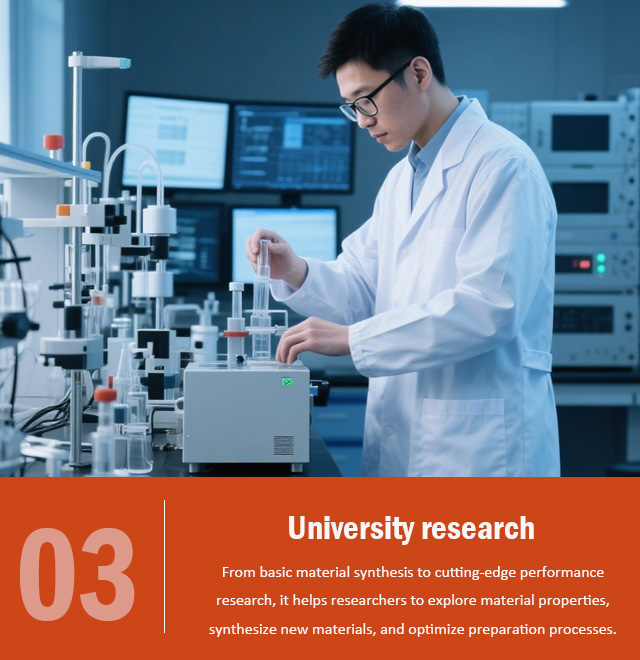
With precise multi-zone temperature control capability, this equipment is widely used in high-end material synthesis. In the CVD growth of two-dimensional materials, it can realize high-quality growth of single crystal graphene and transition metal sulfides, and prepare high-performance heterostructures via temperature gradient control.
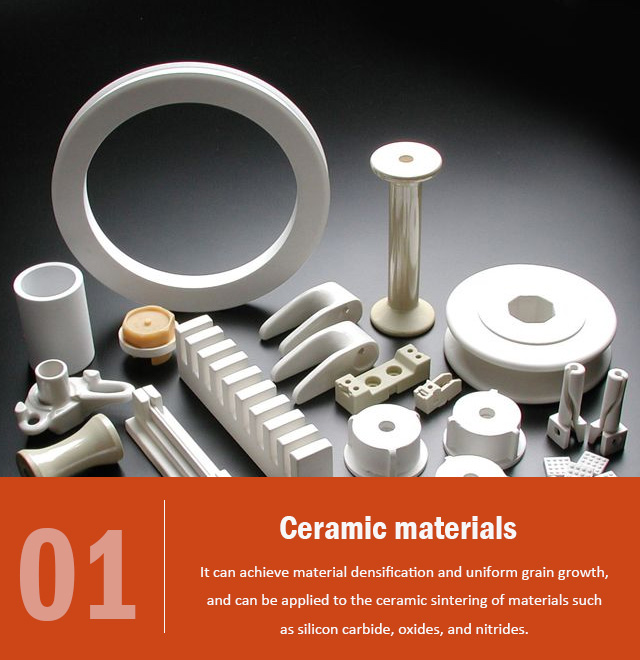
In the field of ceramics and powder metallurgy, it can synthesize functionally graded materials and complete powder sintering through multi-stage heating. It can also prepare high-performance intermetallic compounds such as TiAl and NiAl by precise temperature control of element diffusion reactions.
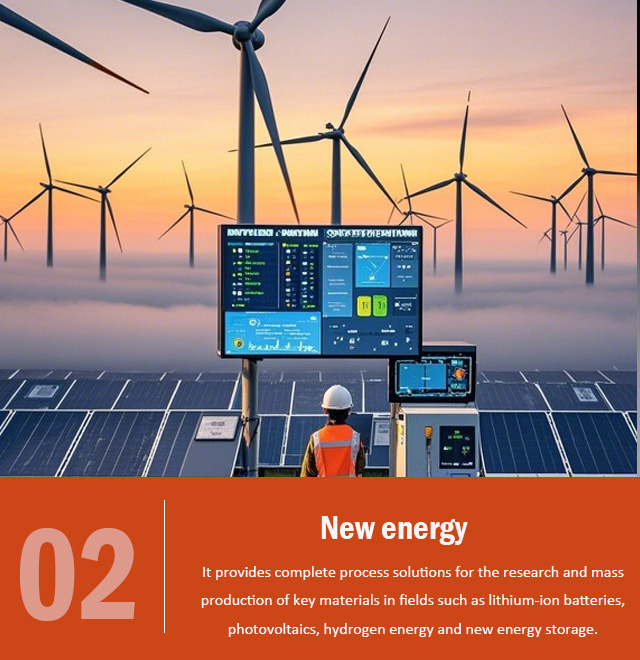
The equipment also plays an important role in semiconductor and new energy materials. It can prepare third-generation semiconductor single crystals such as GaN and SiC by controlling crystal growth rate and orientation, and improve the electrochemical performance of battery cathode materials.
In advanced carbon material preparation, the multi-zone fluidized bed design enables efficient production of carbon nanotubes. Different zones undertake catalyst heating, carbon source input and growth environment regulation respectively, ensuring the purity and quality stability of carbon nanotubes.
4. Future Development Trend
At present, vertical multi-zone tube furnaces are developing towards intelligent customization and automation. On the basis of retaining core temperature control technology, manufacturers continuously optimize equipment configuration to match the R&D and industrialization needs of new materials.
In the future, the equipment will be integrated with full-automatic feeding and discharging systems, online monitoring and intelligent early warning functions, realizing continuous mass production and more precise process control. It will provide strong equipment support for technological innovation in the field of material synthesis.
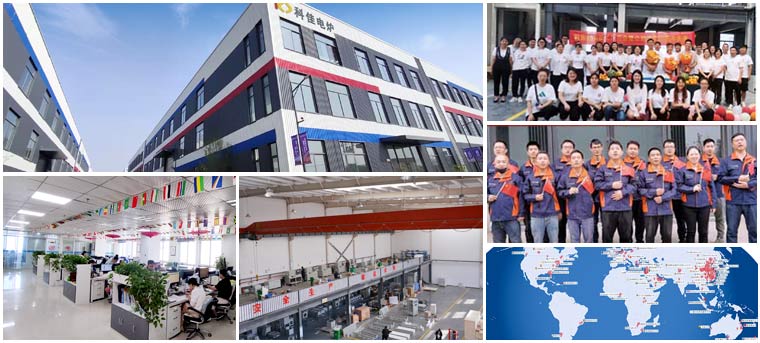
Zhengzhou KJ Technology Co., Ltd. is a high-tech enterprise specializing in the research, development and sales of heat treatment products. Our products cover muffle furnaces, tube furnaces, vacuum furnaces, atmosphere furnaces, CVD/PECVD systems, dental furnaces, bell type furnaces , trolley furnaces, etc., which are widely used in metallurgy, vacuum brazing, ceramic sintering, battery materials, metal processing , parts annealing, additive manufacturing, semiconductors, scientific intelligent instrumentation, aerospace and industrial automatic control systems and other different fields.
Please feel free to contact us.
WhatsApp: +86 18037178440
Email: web@kejiafurnace.com
 English
 简体中文
简体中文 Русский язык
 Français
 日本語
日本語 한국어
한국어 Português
 Español
 Website navigation
 Position:








 Send E-mail:web@kejiafurnace.com
 Wechat/Whatsapp: +86 18037178440
 Company Tell: +(86)18037178440




 E-mail:web@kejiafurnace.com
 Tell:+(86) 18037178440
 Whatapp:+(86) 180-3717-8440
 Address:Room 1505, Building 9, No. 26 Dongqing Street, Zhengzhou High-tech Industrial Development Zone