Furnace Tube Blockage: Causes and Solutions by Vibration & Airflow Assistance
1. General OverviewAn undersized furnace tube inner diameter is the main cause of material accumulation and poor airflow, which can be effectively mitigated by vibration and airflow auxiliary systems. In chemical, metallurgical and powder processing industries, furnace tube inner diameter determines gas-solid flow stability. Most common failures including pressure drop surge and material caking stem from narrow tube diameter. This article analyzes the blockage mechanism and introduces vibration & airflow solutions for industrial furnace tube maintenance.2. Mechanism Analysis of Material Accumulation and Poor Airflow Caused by Small Furnace Tube Inner Diameter2.1 Increased Fluid Resistance and Unbalanced Gas-Solid Flow (Root Cause of Accumulation)
Narrow inner diameter increases fluid resistance and breaks gas-solid balance, causing material retention and local accumulation. Smaller tubes generate higher friction and eddy resistance. Narrow flow space reduces particle mobility, making materials adhere to elbows and tube walls. Uneven flow velocity forms low-speed retention zones, resulting in persistent material deposition.
2.2 Secondary Failures Caused by Abnormal Pressure Drop, Forming a Vicious Blockage Cycle
Small-diameter furnace tubes trigger abnormal pressure drop and form a vicious blockage cycle. Insufficient tube diameter causes continuous air pressure loss and increases fan load. Uneven heating leads to material coking, further narrowing the effective diameter. Accumulated deposits reduce heat transfer efficiency, resulting in tube overheating and higher maintenance costs.
2.3 Material Properties Amplify Blockage Defects, Especially for Powder and Viscous Materials
Powder and viscous materials are more susceptible to blockage in small-diameter furnace tubes. Adhesive particles easily agglomerate and cannot disperse in narrow spaces. Industrial data shows that when the inner diameter is less than 8 times the particle size, accumulation rate rises by over 65% and airflow permeability drops by 40%, severely disrupting production continuity.
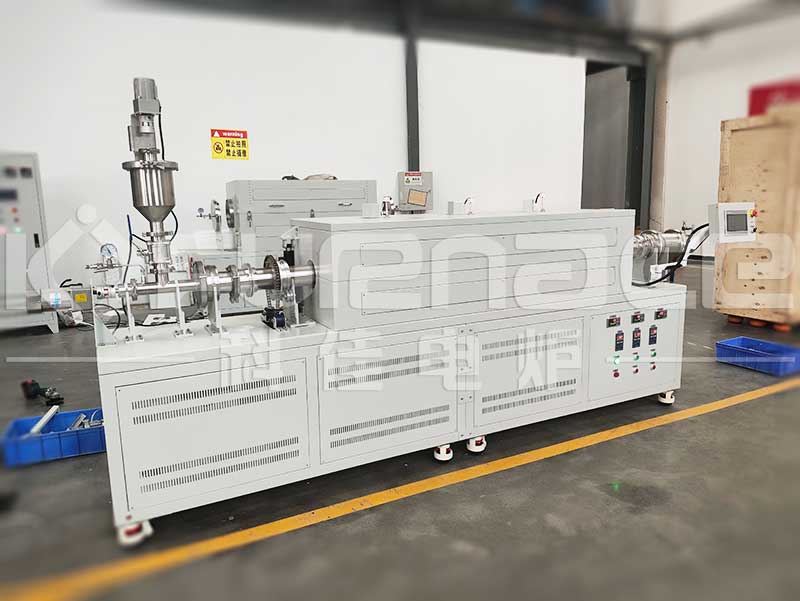
Vibration assistance removes static caking by breaking adhesion between particles and tube walls. High-frequency micro-amplitude vibration peels off deposits without tube disassembly. It helps accumulated materials discharge by self-weight, perfectly fitting high-temperature and airtight industrial working conditions.
3.2 Vibration Device Types: Selection and Adaptation Standards for External and Internal Installation
External and internal vibrators are applicable for different small-diameter furnace tubes. External electromagnetic or pneumatic vibrators (20-200mm tubes) are easy to install without occupying internal space. Internal vibration spoilers prevent dead-angle accumulation. The recommended vibration parameter is 30-50Hz with 0.5-2mm amplitude to avoid tube damage.
3.3 Vibration Usage Specifications: Frequency and Timing Control to Avoid Equipment Damage
Intermittent vibration mode is recommended to avoid equipment deformation and cracking. The optimal setting is 15-30 seconds vibration with 5-10 minutes interval. Vibrators must avoid welding and bending weak points. Vibration alone works for mild-to-moderate accumulation and requires airflow cooperation for stubborn caking.4. Airflow Assistance: Regulation Scheme for Optimizing Airflow and Dredging Dynamic Blockage4.1 Airflow Assistance Principle: Optimize Flow Field and Strengthen Material Carrying and Conveying
Airflow assistance optimizes flow field and enhances material conveying capacity for small-diameter tubes. Compressed air or inert gas eliminates low-speed retention areas and breaks laminar flow. It disperses agglomerated particles, reduces pressure drop loss, and performs better in dynamic material transportation compared with vibration.
4.2 Mainstream Airflow Processes: Purging, Pressurization and Bypass Air Supplement
Three mainstream airflow technologies adapt to different blockage positions. Wall purging suits elbow deposits; front-end pressurization compensates pipeline resistance; bypass air supplement balances pressure for slender tubes. The safe purging pressure range is 0.3-0.8MPa to prevent tube deformation.
4.3 Airflow Parameter Control: Match Material Characteristics to Avoid Secondary Defects
Airflow parameters must be adjusted according to material characteristics. Light powder requires low-speed airflow while hard particles need higher pressure. Isothermal inert gas prevents thermal cracking. Combined with pressure sensors, automatic purging realizes intelligent anti-blockage management.5. Vibration + Airflow Collaborative Optimization Scheme and Industrial Application Suggestions5.1 Collaborative Working Logic: Complementary Advantages of Vibration and Airflow
The combination of vibration and airflow achieves complementary advantages for stubborn blockage. Vibration loosens solid caking and airflow carries away loose materials. This collaborative method requires no major tube modification, featuring low cost and strong adaptability for industrial production.
5.2 Working Condition Classification: Targeted Solutions for Different Blockage Degrees
Different blockage degrees require targeted combined solutions. Mild blockage (pressure drop <10%): intermittent external vibration; Moderate blockage (10%-30%): vibration + low-pressure purging; Severe blockage (>30%): shutdown pulse purging + intensive vibration. Regular scaling cleaning is essential for long-term stable operation.6. SummaryAn undersized inner diameter is the core cause of furnace tube blockage, which can be efficiently solved by matching vibration and airflow auxiliary systems. Vibration removes static deposits while airflow optimizes dynamic flow. For existing small-diameter tubes, retrofitting auxiliary devices is more economical than replacement. Reasonable parameter control reduces failure rate and extends equipment service life, ensuring stable industrial production.
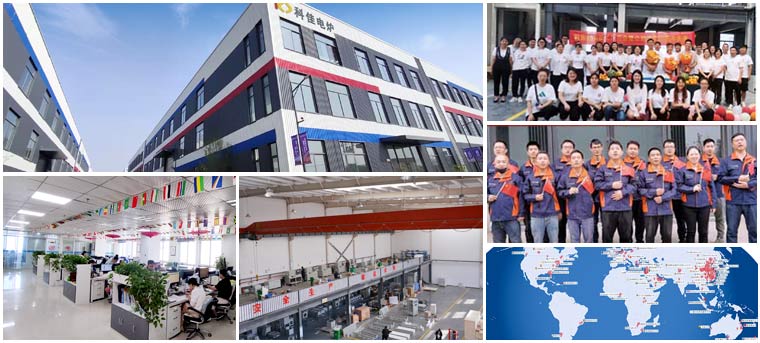
Zhengzhou Kejia Technology Co., Ltd. is a high-tech enterprise specializing in R&D and sales of heat treatment products, including muffle furnaces, tube furnaces, vacuum furnaces and more, widely used in metallurgy, ceramic sintering, battery materials, semiconductors, aerospace and other fields.
For inquiries and customized solutions, contact us via WhatsApp: +86 18037178440 or Email: web@kejiafurnace.com.
 English
 简体中文
简体中文 Русский язык
 Français
 日本語
日本語 한국어
한국어 Português
 Español
 Website navigation
 Position:








 Send E-mail:web@kejiafurnace.com
 Wechat/Whatsapp: +86 18037178440
 Company Tell: +(86)18037178440







 E-mail:web@kejiafurnace.com
 Tell:+(86) 18037178440
 Whatapp:+(86) 180-3717-8440
 Address:Room 1505, Building 9, No. 26 Dongqing Street, Zhengzhou High-tech Industrial Development Zone