Oven Drying for Tube Furnace: First Use Guide
I. Why Is Oven Drying Essential?As a common equipment in high-temperature experiments and industrial production, the tube furnace requires oven drying before its first use, which directly affects the equipment's service life and operational stability. Furnace materials (such as ceramic fiber and alumina fiber insulation layers) absorb physical adsorbed water from the air during manufacturing and storage, and some materials also contain crystal water. Meanwhile, internal stress is likely to occur during processing, cutting, and transportation. If high-temperature operation is performed directly without oven drying, the rapid evaporation of water will cause local stress concentration in the furnace body, leading to cracking and deformation. Unreleased internal stress may result in structural failure and even affect core performances such as thermal insulation and insulation.
Standard oven drying can not only completely remove water and volatile organic compounds but also gradually release internal stress and promote the uniform distribution of components in the furnace materials. Data shows that the thermal conductivity of alumina fiber insulation layers treated by oven drying can be reduced by 10%-15%, significantly improving energy-saving effects and laying a foundation for subsequent stable high-temperature operation.
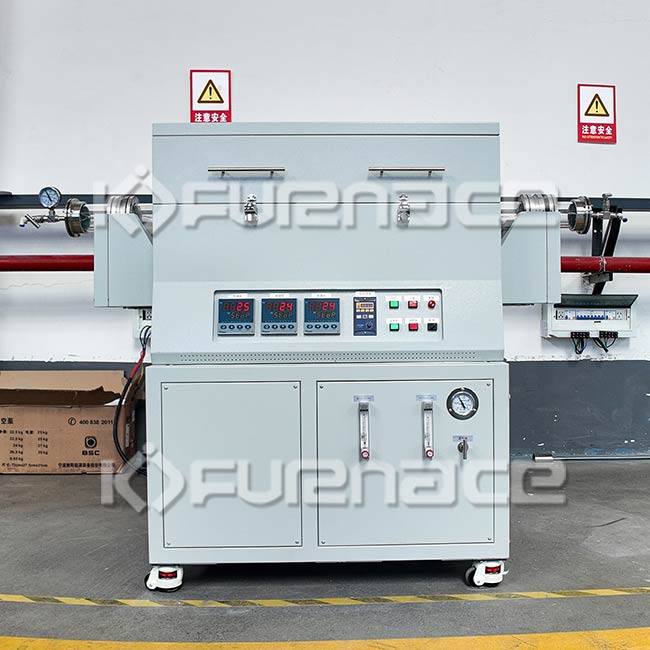
Clean up debris and dust in the furnace chamber to prevent odors or contamination of furnace materials during oven drying;
Connect and debug the temperature control system to ensure the normal operation of sensors and heating elements, and that the temperature display and control accuracy meet the standards.(II) Stepwise Temperature Rise SpecificationsRoom Temperature to 200℃: Heat slowly at a rate of 1-2℃/min and hold for 2-4 hours, focusing on removing physically adsorbed water to avoid violent boiling of water due to excessive heating rate;
200℃ to 500℃: Adjust the heating rate to 2-3℃/min and hold for 4-6 hours, specifically removing crystal water and residual volatile organic compounds;
500℃ to Target Temperature: According to the characteristics of the furnace material (ceramic, quartz, metal, etc.), heat to the set temperature (e.g., 800℃, 1000℃) at a rate of 3-5℃/min and hold for 2-3 hours to complete stress relief and performance stabilization.(III) Cooling PrecautionsAfter oven drying, turn off the heating power and allow the furnace body to cool naturally to room temperature. Do not open the furnace door in advance or force ventilation for cooling, otherwise, the furnace body may crack due to uneven thermal stress.III. Core Precautions for Oven DryingTemperature Uniformity Control: Ensure uniform temperature in the furnace chamber by adjusting the power of heating elements or increasing the number of thermocouples to avoid local overheating. For example, the use of zone temperature control technology can control the furnace temperature difference within ±5℃ during oven drying at 1200℃;
Atmosphere Protection Requirements: If the furnace body is made of metal (such as titanium alloy furnace tube), inert gases such as nitrogen and argon should be introduced during oven drying to control the oxygen content below 10ppm, preventing oxidation and discoloration of the furnace tube;
Process Recording and Verification: Detailedly record the heating rate, holding time, and abnormal phenomena (such as odors and abnormal noises). After oven drying, verify the effect through visual inspection, ultrasonic flaw detection, thermal conductivity measurement, etc., to ensure no local overheating points in the furnace body.IV. Handling Schemes for Special ScenariosLong-term Idle Equipment: For tube furnaces idle for more than 6 months, oven drying should be performed according to the initial use standards before reuse, and the holding time can be appropriately shortened to remove adsorbed water and pollutants;
High-temperature Rapid Heating Requirements: For equipment that needs to be frequently heated to above 1200℃, thermal cycle treatment should be performed after oven drying—repeat the "heating-cooling" cycle near the target temperature (e.g., 1000℃→room temperature→1000℃) multiple times, with an interval of 2 hours between each cycle to further eliminate internal stress;
Vacuum Tube Furnace: Oven drying should be carried out in a low-pressure environment (e.g., 10⁻³ Pa) to avoid damage to the furnace body caused by water vaporization in a vacuum state. The oven drying procedure should be flexibly adjusted according to the performance of the vacuum pump.
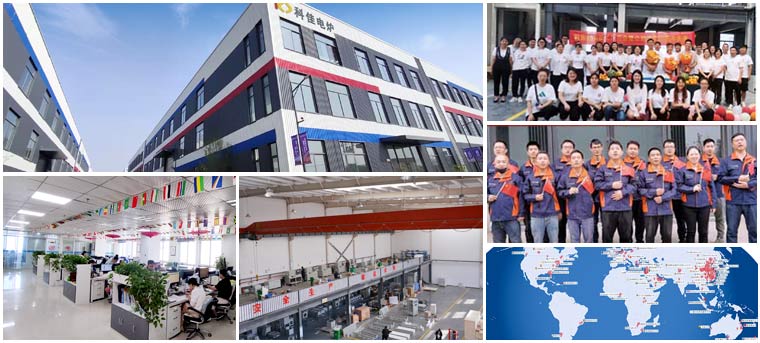
Zhengzhou KJ Technology Co., Ltd. is a high-tech enterprise specializing in the research, development and sales of heat treatment products. Our products cover muffle furnaces, tube furnaces, vacuum furnaces, atmosphere furnaces, CVD/PECVD systems, dental furnaces, bell type furnaces , trolley furnaces, etc., which are widely used in metallurgy, vacuum brazing, ceramic sintering, battery materials, metal processing , parts annealing, additive manufacturing, semiconductors, scientific intelligent instrumentation, aerospace and industrial automatic control systems and other different fields.
Please feel free to contact us.
WhatsApp: +86 18037178440
Email: web@kejiafurnace.com
 English
 简体中文
简体中文 Русский язык
 Français
 日本語
日本語 한국어
한국어 Português
 Español
 Website navigation
 Position:








 Send E-mail:web@kejiafurnace.com
 Wechat/Whatsapp: +86 18037178440
 Company Tell: +(86)18037178440







 E-mail:web@kejiafurnace.com
 Tell:+(86) 18037178440
 Whatapp:+(86) 180-3717-8440
 Address:Room 1505, Building 9, No. 26 Dongqing Street, Zhengzhou High-tech Industrial Development Zone