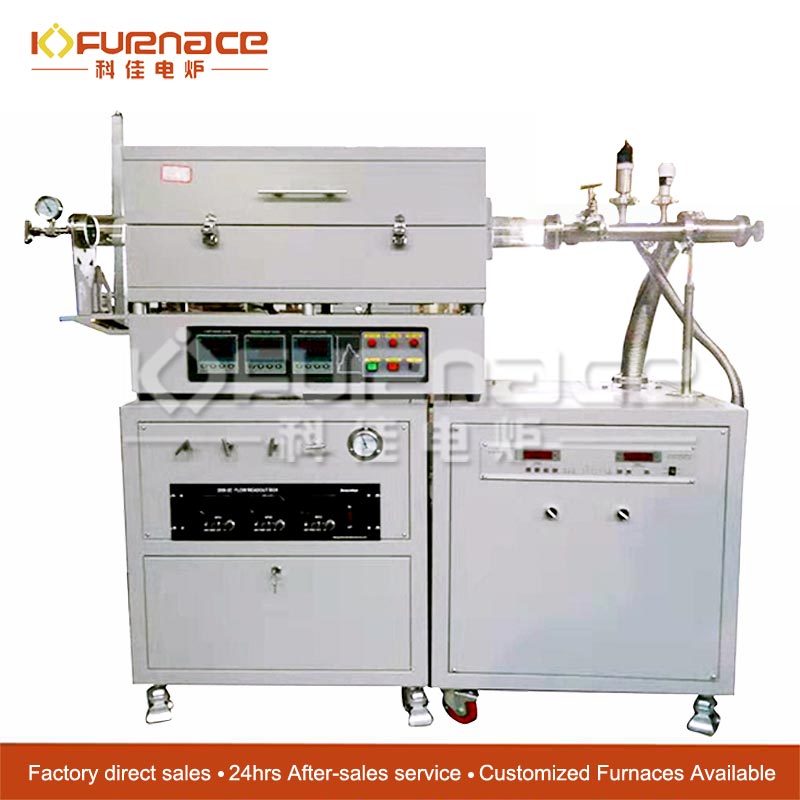
How to Choose the Gas Mixing Channels for CVD Tube Furnaces
IntroductionCVD (Chemical Vapor Deposition) tube furnaces are widely used in material science, semiconductor manufacturing, and other high-tech fields. The number of gas mixing channels is a key parameter that directly affects the accuracy of gas ratio control, process stability, and final product quality. Choosing the right number of gas mixing channels requires a comprehensive analysis of multiple factors to balance experimental needs, cost-effectiveness, and safety. This article will detail the core considerations for selecting the appropriate gas mixing channels for CVD tube furnaces.
Key Factors for Selecting Gas Mixing Channels1. Experimental Requirements and Process ComplexityThe complexity of the experimental process is the primary basis for determining the number of gas mixing channels:
Simple Processes: For experiments that only require 2-3 gases for mixing reactions (e.g., basic thin-film deposition with a reactant gas and a carrier gas), a 2-channel or 3-channel gas mixing system is sufficient. These systems feature a simple structure, easy operation, and lower procurement costs, making them ideal for basic laboratory research or small-batch production.
Complex Processes: For advanced processes that demand stable mixing of multiple gases to achieve specific material properties (e.g., multi-component film synthesis, precise doping, or complex chemical reactions), a 4-channel or 5-channel gas mixing system is recommended. Such systems offer greater flexibility in adjusting gas ratios and ensure more precise flow control, which is crucial for improving the uniformity and quality of deposited films or synthesized materials.2. Gas Types and Flow Control PrecisionGas Types: In CVD processes, gases serve different roles—some act as reactants, others as carrier gases or diluents. The number of gas mixing channels must match the types of gases required for the experiment to ensure each gas can be independently controlled. For example, if an experiment involves two reactant gases, one carrier gas, and one diluent gas, a 4-channel system is necessary to avoid cross-contamination and ensure accurate proportioning.
Flow Control Precision: Stable and precise gas flow control is essential for consistent CVD processes. If the experiment has strict requirements for flow stability (e.g., nanomaterial synthesis or semiconductor fabrication), it is necessary to select a gas mixing system equipped with high-precision flow meters (such as mass flow controllers, MFCs). Increasing the number of channels can further enhance control reliability by reducing mutual interference between gases.3. Equipment Cost and Space ConstraintsCost Considerations: The number of gas mixing channels is directly proportional to equipment costs, including hardware procurement, installation, commissioning, and long-term maintenance. More channels require additional flow meters, valves, and control modules, which increase overall investment. Therefore, it is important to balance experimental needs and budget to select a cost-effective solution—avoid overconfiguring channels that are not required for current or future processes.
Space Constraints: Laboratory space is a practical factor that cannot be ignored. Excessive gas mixing channels will occupy more space, affecting the layout of other equipment and operational convenience. Before selection, measure the available laboratory space and ensure the system can be installed in a way that facilitates daily operation and maintenance.4. Safety and Stability RequirementsSafety: CVD processes often involve toxic, flammable, or explosive gases (e.g., hydrogen, ammonia, silane). When selecting the number of gas mixing channels, prioritize systems with comprehensive safety features, such as gas leak detection sensors, emergency shutoff valves, and pressure relief devices. Ensure that the channel design does not increase safety risks—for example, avoiding excessive pipeline connections that could lead to leaks.
Stability: The stability of the gas mixing system directly impacts the repeatability of CVD experiments and product quality. Choose systems with reliable performance and stable operation, and configure the number of channels based on experimental needs. An overly simplified system may fail to meet process requirements, while an excessively complex system with redundant channels can increase the risk of malfunctions.ConclusionSelecting the right number of gas mixing channels for CVD tube furnaces is a systematic decision that requires integrating experimental requirements, process complexity, gas types, flow control precision, cost, space, and safety. For simple processes, 2-3 channels are cost-effective and practical; for complex, high-precision processes, 4-5 channels are recommended to ensure process stability and product quality. By comprehensively evaluating these factors, researchers and engineers can choose a gas mixing system that best suits their needs, laying a solid foundation for efficient and reliable CVD experiments.
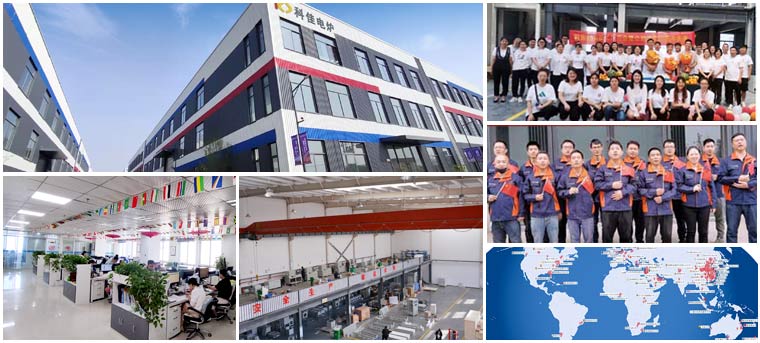
Zhengzhou KJ Technology Co., Ltd. is a high-tech enterprise specializing in the research, development and sales of heat treatment products. Our products cover muffle furnaces, tube furnaces, vacuum furnaces, atmosphere furnaces, CVD/PECVD systems, dental furnaces, bell type furnaces , trolley furnaces, etc., which are widely used in metallurgy, vacuum brazing, ceramic sintering, battery materials, metal processing , parts annealing, additive manufacturing, semiconductors, scientific intelligent instrumentation, aerospace and industrial automatic control systems and other different fields.
Please feel free to contact us.
WhatsApp: +86 18037178440
Email: web@kejiafurnace.com
 English
 简体中文
简体中文 Русский язык
 Français
 日本語
日本語 한국어
한국어 Português
 Español
 Website navigation
 Position:









 Send E-mail:web@kejiafurnace.com
 Wechat/Whatsapp: +86 18037178440
 Company Tell: +(86)18037178440



 E-mail:web@kejiafurnace.com
 Tell:+(86) 18037178440
 Whatapp:+(86) 180-3717-8440
 Address:Room 1505, Building 9, No. 26 Dongqing Street, Zhengzhou High-tech Industrial Development Zone