Tar Formation, Treatment and Exhaust Gas Purification Technology of Biomass Pyrolysis Furnace
1. Industry Overview: Tar Hazards and Purification Value of Biomass Pyrolysis
1.1 Tar Generation Characteristics in Industrial Pyrolysis
Pyrolysis tar is an inevitable by-product of lignocellulosic biomass thermal conversion, with complex components, strong viscosity and easy condensation, which is the core bottleneck restricting clean and stable operation of pyrolysis furnaces.
In industrial operation of agricultural and forestry solid waste pyrolysis furnaces, biomass materials such as straw, wood chips and branches undergo thermal decomposition under oxygen-limited high temperature. While generating biochar, bio-oil and combustible syngas, macromolecular organic tar by-products are inevitably produced. Pyrolysis tar is a complex mixture of aromatic hydrocarbons, phenols, esters and heterocyclic organics featuring high viscosity and poor fluidity. It exists in gaseous state in high-temperature flue gas and condenses into viscous liquid below 200℃, adhering to pipelines, heat exchangers and fans, serving as a key technical difficulty in industrial biomass pyrolysis.
Unremoved tar will cause pipeline blockage, equipment corrosion and system heat efficiency attenuation, and will also form toxic exhaust emissions, affecting production safety and environmental compliance.
In terms of equipment operation hazards: condensed tar adheres to the inner wall of flue pipes and heat exchange equipment, accumulating for a long time to cause pipeline blockage, increased flue gas resistance, reduced furnace internal pressure stability, and even equipment shutdown failure. Tar contains acidic corrosive components, which will cause electrochemical corrosion on metal equipment and shorten the service life of pyrolysis furnace and supporting systems. In terms of environmental hazards: incomplete tar treatment will lead to tar mist and volatile organic compounds entering the exhaust gas, forming malodorous flue gas and toxic and harmful emissions, failing to meet industrial environmental protection discharge standards, and restricting the long-term and stable operation of pyrolysis projects.
1.3 Industrial Value of Integrated Tar and Exhaust Gas Purification
Precise tar control and complete exhaust gas purification are the core guarantees for high yield of pyrolysis products, stable equipment operation and clean production of the whole system.
The integrated tar and exhaust gas purification technology solves typical defects of traditional pyrolysis processes including tar blockage, low gas purity and substandard flue gas emission. It realizes three core industrial values through targeted tar generation suppression, efficient tar removal and in-depth exhaust purification: first, protect continuous and stable operation of pyrolysis furnace equipment and reduce maintenance costs; second, improve the purity of combustible syngas and bio-oil products and enhance product economic value; third, realize zero emission of clean flue gas and meet the environmental protection assessment standards of solid waste resource utilization projects.
2. Formation Mechanism and Key Influencing Factors of Pyrolysis Tar
2.1 Staged Tar Generation Principle
Tar is produced in the process of staged thermal decomposition and secondary polymerization of biomass components, forming light tar and heavy tar with different properties in different temperature intervals.
Biomass hemicellulose, cellulose and lignin have different thermal stability, resulting in staged tar generation rules. Hemicellulose decomposes at 200–350℃ to form light volatile tar with small molecular weight, which is easy to gasify and condense; cellulose cracks at 300–450℃ to produce a large number of tar precursors, which are the main source of medium tar; lignin has a wide pyrolysis temperature range, and macromolecular heavy tar is massively generated above 450℃, with high viscosity and difficult removal. In the furnace, small-molecule volatile substances will undergo secondary polymerization and recombination with the increase of residence time, further increasing tar molecular weight and system tar content.
2.2 Raw Material Characteristic Influencing Factors
Raw material type, moisture content and particle size directly determine tar generation amount and tar component distribution in pyrolysis reaction.
Woody biomass such as branches and bark has high lignin content, and the heavy tar yield is high during pyrolysis; herbaceous biomass such as straw and rice husk has high cellulose and hemicellulose content, and light tar is the main product. Excess raw material moisture will lead to incomplete low-temperature pyrolysis, increased volatile polymerization reaction and increased tar production. Excessively large raw material particle size results in uneven internal and external heating, incomplete pyrolysis of internal materials and a large number of intermediate tar products, while excessively fine particles will cause rapid overflow of volatiles and increased secondary tar generation.
2.3 Core Process Parameter Control Mechanism
Pyrolysis temperature, heating rate and flue gas residence time are the three core process parameters that dominate tar yield and properties.
Temperature is the most critical factor: low-temperature pyrolysis below 400℃ has insufficient cracking reaction and high total tar yield; medium and high temperature above 600℃ can realize secondary cracking of macromolecular tar into small-molecule combustible gas, significantly reducing tar content. Slow heating rate leads to long-term low-temperature heat preservation of materials and increased tar polymerization; fast heating can shorten low-temperature reaction time and inhibit tar generation. Excessively long flue gas residence time will aggravate tar secondary polymerization, while excessively short residence time leads to incomplete tar cracking, which needs precise coupling control according to raw material characteristics.
3. Mainstream Tar Treatment Technologies and Technical Adaptability
3.1 Physical Tar Removal Technology (Washing and Adsorption)
Physical tar removal relies on condensation, washing and adsorption to capture tar droplets and macromolecular tar, featuring simple process and stable operation, suitable for conventional industrial purification scenarios.
Physical tar removal technology includes water washing method, oil washing method and solid adsorption method. The water washing scrubber uses circulating cooling water to contact pyrolysis flue gas in reverse phase, condensing and dissolving tar droplets in water, with low operating cost and convenient operation, but easy to produce tar-containing wastewater. The oil washing method uses high-boiling organic solvent to absorb tar, with high removal efficiency and recyclable absorbent. The solid adsorption method uses biomass biochar, activated carbon and molecular sieve as adsorbents to capture tar molecules, which is suitable for deep tar removal, with removal efficiency up to 95% and no secondary pollution.
3.2 High-Temperature Thermal Cracking Tar Reduction Technology
High-temperature thermal cracking converts macromolecular tar into small-molecule combustible gas, realizing tar resource utilization and fundamentally reducing tar content.
The high-temperature thermal cracking principle is to heat pyrolysis flue gas to 700–900℃ to break the molecular chain of macromolecular tar, so that complex tar components are cracked into H₂, CO, CH₄ and other clean combustible gases. This technology does not produce solid waste and wastewater, realizing tar reduction and resource recovery. The tar cracking conversion rate can reach more than 85%, which significantly improves the calorific value of syngas. It is suitable for large-scale continuous pyrolysis production lines, but requires precise temperature control and high equipment heat resistance.
3.3 Catalytic Cracking and Electrostatic Composite Purification Technology
Catalytic cracking reduces tar reaction activation energy, and electrostatic tar removal captures fine tar mist, forming a high-efficiency composite tar removal scheme for high-standard production scenarios.
Catalytic cracking uses dolomite, olivine, nickel-based catalysts to reduce the tar cracking temperature to 500–700℃, achieving low-energy and high-efficiency tar decomposition with a conversion rate of more than 90%. The electric tar catcher uses high-voltage electric field to ionize flue gas, charge fine tar mist and dust particles, and adsorb them on the electrode plate for collection, which has an excellent removal effect on micron-level fine tar that is difficult to remove by conventional physical methods. The composite process of catalytic cracking + electrostatic tar removal is suitable for high-end pyrolysis projects with high requirements for syngas purity and ultra-clean flue gas discharge.
4. System Composition, Working Principle and Parameter Control of Exhaust Gas Purification
4.1 Overall Process Architecture of Integrated Purification System
The exhaust gas purification system adopts the integrated process of preliminary dust removal, graded tar removal, dehumidification and adsorption, and terminal advanced treatment to realize full-standard clean flue gas discharge.
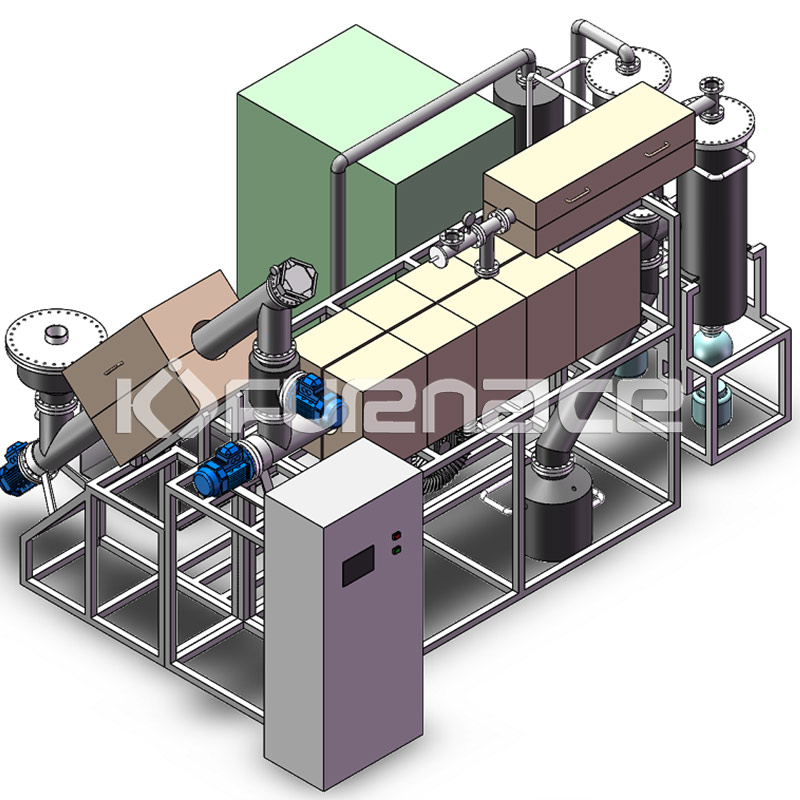
The complete pyrolysis exhaust gas purification system consists of five core modules: first, cyclone dust removal module, removing large particle dust and impurities in flue gas to avoid subsequent equipment blockage; second, graded tar removal module, combining condensation washing and electrostatic capture to remove heavy tar and light tar mist in stages; third, gas-liquid separation and dehumidification module to reduce flue gas humidity and eliminate water mist interference; fourth, activated carbon adsorption deep purification module to remove residual volatile tar and organic waste gas; fifth, terminal detection and discharge module to ensure flue gas indicators meet environmental protection standards.
4.2 Core Equipment Operation Logic
Dust collector, scrubber, electric tar catcher, adsorption tower and dehumidifier cooperate step by step to realize gradient purification of pyrolysis exhaust gas from coarse to fine.
The cyclone dust collector completes primary impurity removal to block particulate impurities; the counter-current scrubber cools flue gas while washing most of the condensed tar; the high-efficiency electric tar catcher captures fine tar mist that is not completely washed; the gas-liquid separator removes residual water droplets in flue gas to prevent adsorption material failure; the activated carbon adsorption tower deeply adsorbs trace organic waste gas and residual tar components. All equipment operates in a closed loop, with linkage control of temperature, pressure and flow parameters, realizing automatic operation of the purification system and stable exhaust gas indicators.
4.3 Key Points of System Parameter Control
Flue gas temperature, circulating liquid flow, electric field voltage and adsorption residence time are the key parameters to ensure stable and efficient operation of the purification system.
Control the flue gas inlet temperature at 180–220℃ to ensure effective condensation and separation of heavy tar; adjust the circulating water flow of the scrubber according to the flue gas volume to avoid insufficient washing or excessive water consumption; stably control the working voltage of the electric tar catcher to ensure full ionization and capture of fine tar mist; match the adsorption residence time according to the exhaust gas concentration to avoid incomplete adsorption of residual pollutants. Reasonable parameter coupling can maximize tar removal efficiency and exhaust gas purification effect, and reduce system operation energy consumption and secondary pollution.
5. Working Condition Matching, Industrial Optimization and Benefit Analysis
5.1 Process Selection for Different Pyrolysis Scenarios
Targeted purification schemes are matched for small decentralized, medium standardized and large high-end pyrolysis projects to balance cost, efficiency and operational stability.
For small-scale decentralized pyrolysis projects, adopt cyclone dust removal + water washing purification process, with low investment and simple operation, suitable for rural distributed pyrolysis equipment with small processing capacity. For medium-scale standardized projects, adopt dust removal + water washing + electrostatic tar removal + adsorption composite process, with balanced efficiency and cost, which is the mainstream industrial matching scheme with strong raw material adaptability and stable operation. For large-scale high-end industrial parks, adopt high-temperature catalytic cracking + electrostatic tar removal + advanced deep adsorption process, realizing tar resource utilization and ultra-clean exhaust gas discharge, with excellent comprehensive environmental and economic benefits.
5.2 Common Industrial Bottlenecks and Optimization Schemes
Unreasonable process matching, equipment blockage, tar wastewater secondary pollution and incomplete deep purification are optimized through graded treatment, closed-loop circulation and intelligent control.
Current industrial bottlenecks include incomplete tar removal by single process, frequent pipeline blockage caused by tar condensation, secondary pollution of tar-containing wastewater from traditional water washing, and unstable flue gas emission indicators due to insufficient terminal purification. Corresponding optimization measures are adopted: implement staged graded tar removal to improve efficiency and avoid blockage; build tar wastewater closed-loop recycling system to eliminate secondary pollution; equip intelligent temperature and pressure linkage system to adapt to variable working conditions; upgrade terminal composite adsorption and deodorization technology to realize ultra-clean exhaust gas discharge.
5.3 Environmental and Economic Dual Benefits
The integrated tar and exhaust gas purification system solves flue gas pollution problems, reduces equipment failure rate, and improves the comprehensive economic benefits and operational compliance of pyrolysis projects.
In terms of environmental benefits, it completely eliminates tar flue gas emission and odor pollution, realizing standard and ultra-low emission of pyrolysis exhaust gas, which meets the policy requirements of solid waste resource utilization and low-carbon environmental protection. In terms of economic benefits, efficient tar removal avoids pipeline blockage and equipment corrosion, reducing equipment maintenance and replacement costs; tar cracking and recycling improve syngas yield and calorific value to increase project income; stable compliant operation avoids environmental penalty risks and ensures long-term stable profit of pyrolysis projects.
6. Technical Iteration and Future Industry Development Trend
Intelligent directional tar suppression and resource-based tar disposal technology have become the core upgrading direction of pyrolysis flue gas purification industry.
Traditional post-purification mode is gradually iterated to the integrated technology of "source suppression + process control + terminal purification". The industry is developing towards precise regulation of pyrolysis parameters to reduce tar generation from the source, intelligent monitoring of flue gas tar content, and automatic matching of purification process parameters. Catalytic material upgrading and low-energy electrostatic tar removal technology continuously reduce system energy consumption and improve purification efficiency and operational stability.
Zero-waste tar resource utilization and ultra-low emission integrated system will further enhance the industrial value of biomass pyrolysis projects.
In the future, the tar governance and exhaust gas purification system will realize full closed-loop resource utilization: waste tar is fully cracked into available clean energy, tar wastewater is recycled in a closed loop, and terminal flue gas realizes ultra-low emission. Through the deep integration of source control, process optimization and terminal deep purification, the clean production level of biomass pyrolysis industry will be comprehensively improved, helping the high-quality and sustainable development of agricultural and forestry solid waste resource recycling economy.
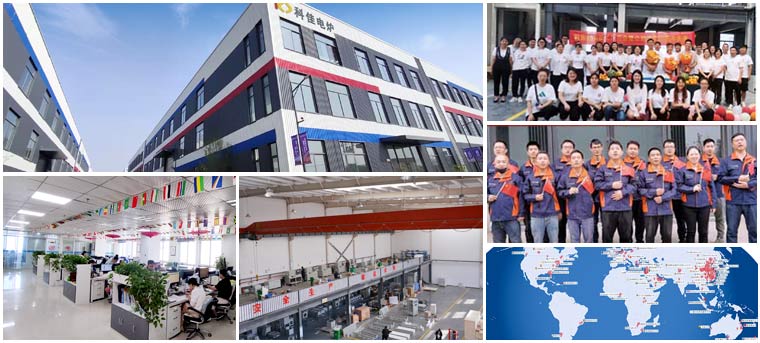
Zhengzhou Kejia Technology Co., Ltd. is a high-tech enterprise specializing in R&D and sales of heat treatment products, including muffle furnaces, tube furnaces, vacuum furnaces and more, widely used in metallurgy, ceramic sintering, battery materials, semiconductors, aerospace and other fields.
For inquiries and customized solutions, contact us via WhatsApp: +86 18037178440 or Email: web@kejiafurnace.com.
 English
 简体中文
简体中文 Русский язык
 Français
 日本語
日本語 한국어
한국어 Português
 Español
 Website navigation
 Position:








 Send E-mail:web@kejiafurnace.com
 Wechat/Whatsapp: +86 18037178440
 Company Tell: +(86)18037178440






 E-mail:web@kejiafurnace.com
 Tell:+(86) 18037178440
 Whatapp:+(86) 180-3717-8440
 Address:Room 1505, Building 9, No. 26 Dongqing Street, Zhengzhou High-tech Industrial Development Zone