Technical Difficulties in Lithium Sulfide Preparation for Solid Electrolytes
1. Core Background of Lithium Sulfide Sintering Furnace SpecificityAs the core raw material of sulfide solid electrolytes, lithium sulfide features easy oxidation and hydrolysis, ultra-low impurity tolerance, and release of highly toxic hydrogen sulfide during sintering. Conventional sintering furnaces fail to meet its process requirements, making lithium sulfide sintering furnaces a core bottleneck equipment in the mass production of sulfide solid electrolytes. This special heat treatment equipment is designed for sintering lithium sulfide and subsequent sulfide electrolyte precursors, and its design and process adaptability directly determine the purity of lithium sulfide products and the performance of follow-up solid electrolytes.
2. Core Process Requirements for Lithium Sulfide SinteringLithium sulfide sintering conditions are far stricter than ordinary lithium battery materials, forming the core basis for sintering furnace design, with four key requirements:
Extreme oxygen-free and water-free environment: Lithium sulfide hydrolyzes into toxic hydrogen sulfide when exposed to water and oxidizes into lithium sulfate and other impurities in oxygen. The water and oxygen content in the furnace must be stably controlled below 1ppm, with complete isolation from outside air throughout the process.
Low impurity pollution control: Sulfide solid electrolytes have a tolerance of ≤10ppm for iron, silicon, aluminum and other impurities. Excessive impurities will directly reduce ionic conductivity, so impurity precipitation from the furnace must be avoided during sintering.
High-precision temperature and thermal field control: The conventional sintering temperature of lithium sulfide is 600~900℃, with strict requirements for thermal field uniformity. Uneven thermal field will cause large crystallinity differences of lithium sulfide, leading to obvious performance fluctuations of subsequent electrolytes.
Full airtightness and safety protection: The equipment adopts a fully sealed structure with professional hydrogen sulfide treatment devices to prevent toxic gas leakage. Meanwhile, the volatilized sulfur during sintering should be recovered to reduce raw material loss.3. Main Types and Adaptability of Lithium Sulfide Sintering EquipmentAccording to production capacity and R&D stages, lithium sulfide sintering equipment is mainly divided into three types, each with distinct applicable scenarios and process characteristics:
High vacuum atmosphere box furnaces are suitable for laboratory small-batch R&D, with low cost and high flexibility, processing gram-level samples per batch for formula optimization. However, they have low productivity and poor product consistency, which is not suitable for mass production.
High-purity corundum push plate furnaces are used for pilot and small-to-medium scale mass production, adopting semi-continuous production and processing ton-level materials per batch. But static sintering easily causes material agglomeration, which requires subsequent crushing and grinding and thus brings in impurities, affecting product purity.
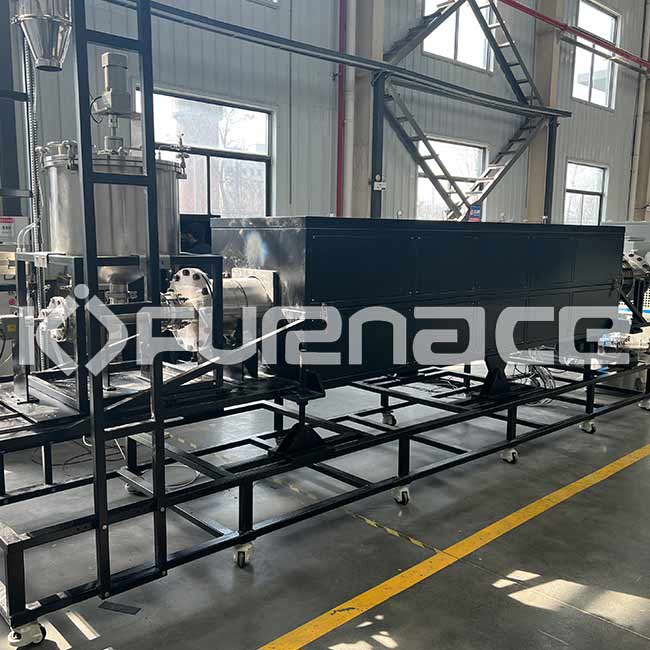
Special coated alloy inner liner rotary kilns are the mainstream in the industry, applicable for both R&D and mass production. With dynamic sintering, materials are continuously turned for uniform heating, fundamentally solving agglomeration, and the discharge rate is over 30% higher than push plate furnaces. Its anti-corrosion coated inner liner resists sulfur vapor corrosion, adapting to long-term lithium sulfide sintering.4. Key Structural Design Points of Lithium Sulfide Sintering FurnaceDifferent from conventional sintering furnaces, lithium sulfide sintering furnaces are custom-designed around impurity control, atmosphere stability, thermal field uniformity, safety protection and raw material recovery, with the following key points:
Special inner liner/furnace material: Ordinary iron-containing refractories are strictly prohibited. The mainstream solutions are 99.9% high-purity corundum furnaces or Hastelloy/Inconel alloy inner liners coated with 1~2mm boron nitride/silicon carbide, avoiding iron impurity precipitation and resisting sulfur vapor corrosion.
High-precision atmosphere control system: Equipped with a pre-argon purification device and on-line water-oxygen monitor, the furnace maintains a micro-positive pressure of 100~200Pa to prevent air infiltration. Excessive oxygen will trigger an automatic alarm, cutting off heating and filling high-purity argon for emergency protection.
Optimized thermal field design: 3~5 independent temperature zones with PID precise control and heat equalizing liners inside the furnace effectively avoid local over-sintering and under-sintering, reducing lithium sulfide crystallinity differences fundamentally.
High-grade sealing and safety configuration: The fully welded sealed furnace body is equipped with double-stage magnetic seals at dynamic sealing parts to lower leakage rate. It also has hydrogen sulfide concentration alarms and two-stage tail gas treatment devices (alkali liquid absorption + activated carbon adsorption), which automatically start emergency argon filling and exhaust programs in abnormal situations to ensure production safety.
Sulfur recovery design: A condensation recovery device at the furnace exhaust end recycles volatilized sulfur, reducing raw material loss by over 10% and lessening sulfur vapor corrosion to subsequent pipelines, extending the overall equipment service life.5. Current Industry Pain Points and Technical Development Trends(1) Core Industry Pain Points
Unresolved high-temperature sulfur vapor corrosion: The service life of conventional alloy inner liners in high-temperature sulfur vapor is only about 2 years, and the high replacement cost becomes a core cost pain point in mass production.
Low static sintering yield: The yield of static sintering is only 60%~70%. Crushing and grinding after agglomeration easily introduces impurities, affecting product purity and electrolyte performance.
Poor consistency of small-batch customized sintering: Current equipment cannot accurately control process parameters for small-batch customized sintering, leading to poor performance consistency of different product batches.
(2) Core Technical Development Directions
Anti-corrosion and wear-resistant composite coated inner liner: New zirconium-based ceramic coated inner liners can extend the service life to over 5 years, reduce material wall sticking rate, and further improve discharge efficiency and product purity.
Upgraded dynamic stirring sintering technology: Adding a stirring structure inside the rotary kiln achieves more uniform heating and mixing of materials, raising the yield to over 90% and eliminating subsequent crushing processes, thus avoiding impurity introduction fundamentally.
Fully airtight linked production line: The sintering furnace is fully sealed with glove boxes for precursor feeding and product discharging, realizing air-free sintering of lithium sulfide, completely avoiding oxidation and hydrolysis risks, and ensuring stable product quality.
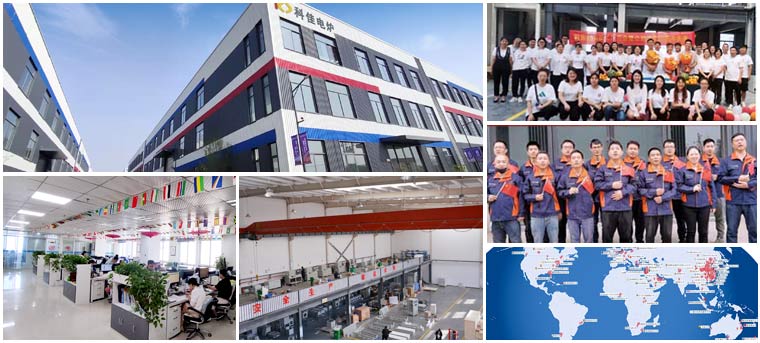
Zhengzhou KJ Technology Co., Ltd. is a high-tech enterprise specializing in the research, development and sales of heat treatment products. Our products cover muffle furnaces, tube furnaces, vacuum furnaces, atmosphere furnaces, CVD/PECVD systems, dental furnaces, bell type furnaces , trolley furnaces, etc., which are widely used in metallurgy, vacuum brazing, ceramic sintering, battery materials, metal processing , parts annealing, additive manufacturing, semiconductors, scientific intelligent instrumentation, aerospace and industrial automatic control systems and other different fields.
Please feel free to contact us.
WhatsApp: +86 18037178440
Email: web@kejiafurnace.com
 English
 简体中文
简体中文 Русский язык
 Français
 日本語
日本語 한국어
한국어 Português
 Español
 Website navigation
 Position:









 Send E-mail:web@kejiafurnace.com
 Wechat/Whatsapp: +86 18037178440
 Company Tell: +(86)18037178440



 E-mail:web@kejiafurnace.com
 Tell:+(86) 18037178440
 Whatapp:+(86) 180-3717-8440
 Address:Room 1505, Building 9, No. 26 Dongqing Street, Zhengzhou High-tech Industrial Development Zone