English
 简体中文
简体中文 Русский язык
 Français
 日本語
日本語 한국어
한국어 Português
 Español
 Website navigation
 Position:





Tel Number
180-3717-8440



1. Introduction
With the rapid development of aerospace, new energy and high-end equipment manufacturing, the demand for large-scale ceramic components (e.g., ceramic matrix composite guide vanes, ultra-large ceramic insulating sleeves) is growing sharply. These components feature large size, complex shapes and strict performance requirements, imposing high demands on the stability, load-bearing capacity and temperature field control precision of heating equipment. Trolley furnaces are widely used in large-component heat treatment due to their open furnace space and flexible operation. However, the low density, high brittleness and sintering volume shrinkage of large ceramic components make load-bearing adaptability and temperature field uniformity the core factors determining sintering quality. This paper analyzes these two key aspects to provide technical references for equipment selection and process optimization.
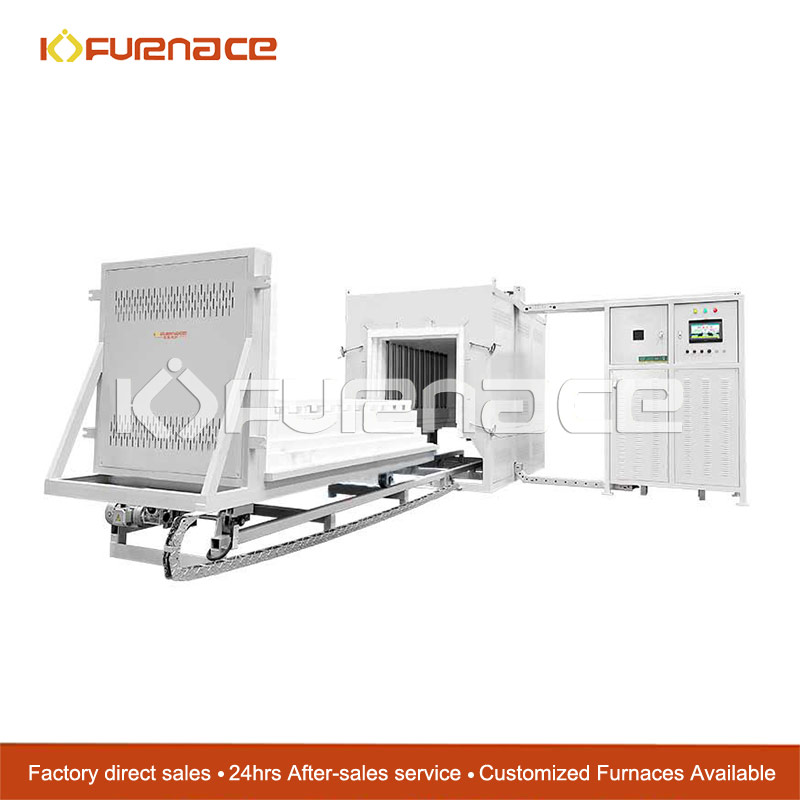
2. Adaptability of Trolley Furnace Load-Bearing Capacity and Large-Scale Ceramic Components
2.1 Load-Bearing Demand Characteristics of Components
Large ceramic components typically reach several meters in size and weigh hundreds of kilograms to tons. Their mechanical properties change significantly during sintering (room temperature to 1200-1800℃): low-temperature stage (room temp-600℃) features high brittleness and poor resistance to impact/deformation, prone to scratches or microcracks from uneven loading; medium-high temperature stage (600℃ to sintering temp) sees phase transformation and glass phase precipitation, reducing strength and causing irreversible deformation like bending due to uneven support; cooling stage shrinkage leads to stress concentration and cracking if the bearing surface is uneven. Multi-layer stacking or complex tooling for some components further complicates the load-bearing system.
2.2 Adaptive Design of Load-Bearing System
The load-bearing system should be optimized in structure, materials and support methods. Structurally, an integral thickened furnace bottom plate (≥50mm) with aging treatment is adopted to avoid high-temperature warping, and reinforcing ribs (spacing ≤800mm) ensure stiffness; the trolley traveling mechanism increases wheel-rail contact area to reduce local pressure. Material-wise, high-temperature stable materials like Cr25Ni20 heat-resistant steel and corundum-mullite composites are preferred; silicon carbide ceramic plates are used for sintering above 1600℃. High-temperature buffer materials (e.g., alumina fiber blankets) are laid between the plate and components to prevent scratches and alleviate thermal stress. For support, distributed blocks are used for flat components, and customized tooling for special-shaped ones to avoid stress concentration, with tooling materials compatible with the sintering atmosphere.
2.3 Verification of Load-Bearing Adaptability
Load-bearing adaptability is verified by static and dynamic tests. Static test: place counterweights equivalent to actual components on the furnace plate at room temperature for 24 hours, requiring deformation ≤0.5mm/m; then conduct high-temperature load-bearing test at rated temperature with sufficient holding time, ensuring no permanent deformation after cooling. Dynamic test: use simulation parts (same material, size, weight as actual components) for full-process sintering, measuring geometric tolerance via 3D scanning. Qualified tolerance and no defects indicate satisfactory load-bearing adaptability.
3. Regulation and Adaptability of Trolley Furnace Temperature Field Uniformity
3.1 Influence of Temperature Field Uniformity
Temperature field uniformity directly determines sintering quality. The sintering process (moisture evaporation, organic decomposition, phase formation, densification) requires strict temperature stability. Uneven temperature causes quality issues: unbalanced densification (abnormal grain growth at high temp, pores at low temp), thermal stress concentration leading to cracking, and dimensional inaccuracy due to uneven shrinkage. A temperature deviation of ±5℃ can cause serious defects for components over 2 meters.
3.2 Core Measures for Temperature Field Regulation
Four key measures regulate temperature field uniformity: 1) Optimize heating layout: multi-sided distributed heating (sides, top, bottom) divided into independent control zones with PID regulation; segmented heating for furnaces over 5 meters. 2) Improve furnace structure: install stainless steel deflectors to eliminate air dead angles, and lay ≥300mm high-density alumina fiber insulation; add insulation covers for special-shaped components. 3) Strengthen air circulation: equip adjustable-speed forced circulation fans for furnaces over 50m³ (low speed at low temp, high speed at high temp) with air distributors. 4) Enhance sealing: double sealing (refractory fiber + silicone rubber) with heating compensation elements at the furnace door; regularly replace aging seals.
3.3 Temperature Field Detection Standards
Temperature field detection follows GB/T 9452-2019. Detection points cover the effective heating zone (component area, corners, upper/lower parts, furnace door vicinity) with at least 1 point per m³ and total ≥9 points. Thermocouples are heated to rated temperature and held for 2 hours; the temperature deviation (max-min) should be ≤±3℃ for general large ceramic components, and strictly ≤±2℃ for high-performance ones (e.g., aerospace applications).
4. Engineering Application Case
A new energy enterprise sintered 3000mm×1500mm×800mm, 2.5-ton ceramic insulating sleeves using a 1600℃ trolley furnace (4000mm×2000mm×1200mm) with adaptive optimization: load-bearing system adopted 60mm Cr25Ni20 plate, 600mm-spacing reinforcing ribs, 5mm alumina fiber blanket and 12 distributed supports, with deformation <0.3mm/m at room and high temp; temperature field used 6-zone multi-sided heating, 2 forced circulation fans and double-sealed furnace door with compensation. Test showed temperature deviation ±2.5℃; sintered sleeves had no defects, and dimensional accuracy/key properties (bending strength, dielectric performance) met industry standards.
5. Conclusion and Prospect
The core of trolley furnace adaptability lies in precise matching of load-bearing capacity and temperature field uniformity. Structural optimization, high-temperature material selection and scientific support ensure load-bearing adaptability; multi-dimensional optimization (heating layout, furnace structure, air circulation, sealing) controls temperature deviation. Future trends include intelligent upgrading (real-time monitoring/regulation via sensors), material innovation (ultra-high temperature materials above 2000℃), and personalized customization (custom tooling/regulation schemes) to improve sintering stability and support high-end equipment manufacturing.
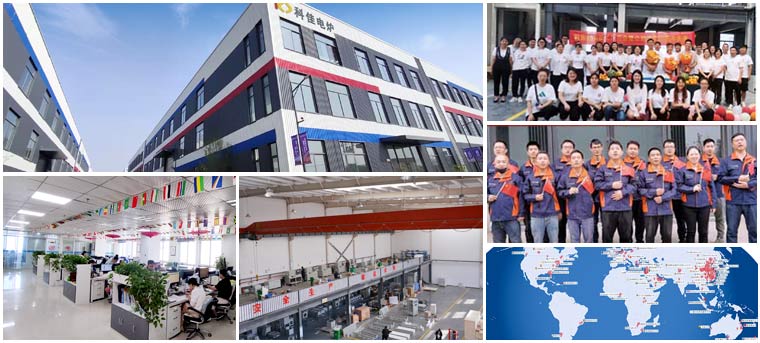
Zhengzhou KJ Technology Co., Ltd. is a high-tech enterprise specializing in the research, development and sales of heat treatment products. Our products cover muffle furnaces, tube furnaces, vacuum furnaces, atmosphere furnaces, CVD/PECVD systems, dental furnaces, bell type furnaces , trolley furnaces, etc., which are widely used in metallurgy, vacuum brazing, ceramic sintering, battery materials, metal processing , parts annealing, additive manufacturing, semiconductors, scientific intelligent instrumentation, aerospace and industrial automatic control systems and other different fields.
Please feel free to contact us.
WhatsApp: +86 18037178440
Email: web@kejiafurnace.com
Hot news
more>>
Inquiry
Please leave a message here. We will reply you in 24 hours.
Contact Information
 Send E-mail:web@kejiafurnace.com
 Wechat/Whatsapp: +86 18037178440
 Company Tell: +(86)18037178440




Professional Process, Effortless Purchase
Click to inquire


 E-mail:web@kejiafurnace.com
 Tell:+(86) 18037178440
 Whatapp:+(86) 180-3717-8440
 Address:Room 1505, Building 9, No. 26 Dongqing Street, Zhengzhou High-tech Industrial Development Zone

Tel Number
180-3717-8440
web@kejiafurnace.com
YouTuBe