Vacuum Sintering Process for Alumina/Zirconia Electronic Ceramics
In high-end fields such as electronic components, new energy, and precision manufacturing, alumina (Al₂O₃) and zirconia (ZrO₂) have become core substrates for electronic ceramics due to their excellent high-temperature resistance, insulation properties, mechanical strength, and chemical stability. As a key process to improve ceramic density, purity, and performance, vacuum sintering’s core lies in the precise adaptation between vacuum furnaces and material characteristics. This article details the sintering solutions for vacuum furnaces adapting to these two materials from four dimensions—process principle, parameter optimization, operation points, and quality control—providing practical guidance for electronic ceramic production.I. Core Advantages of Vacuum Sintering and Material Adaptation LogicVacuum sintering creates an oxygen-poor, non-oxidizing sintering environment by extracting air and impurity gases from the furnace chamber, fundamentally solving problems such as oxidation, porosity, and impurity residue that are prone to occur in traditional atmospheric sintering. For alumina and zirconia, the adaptive value of the vacuum environment is reflected in:
Alumina: Reduces sintering temperature (100-200℃ lower than atmospheric sintering), inhibits abnormal grain growth, improves density (up to 99.5% or higher), and ensures insulation performance and mechanical strength;
Zirconia: Suppresses phase transformation cracking at high temperatures, avoids reactions between zirconia and impurities in the air, and guarantees its wear resistance, corrosion resistance, and biocompatibility (suitable for medical electronic fields).
The differences in lattice structure, thermal expansion coefficient, and sintering activity between the two materials determine that vacuum furnace process parameters need to be adjusted targetedly. The core adaptation logic is the coordinated matching of "temperature-pressure-heating rate-holding time".
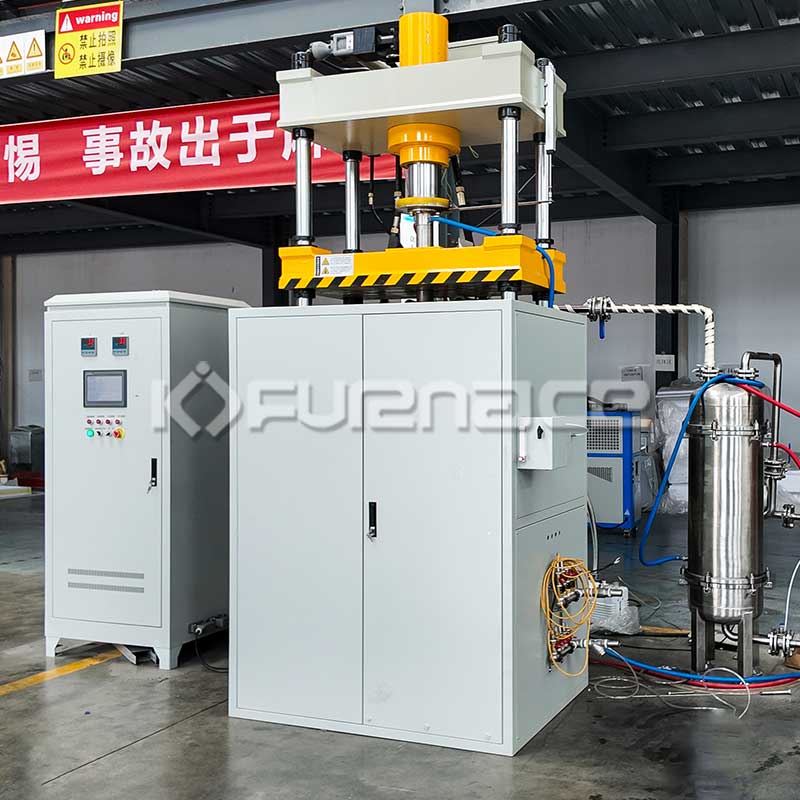
Vacuum Degree Control: Maintain a furnace vacuum degree of ≥10⁻³Pa throughout the sintering process. First evacuate to 10⁻¹Pa during the heating stage to remove air, and increase to above 10⁻³Pa during the holding stage to avoid residual gas forming pores;
Temperature and Heating Rate: From room temperature to 600℃, control the heating rate at 5-8℃/min to remove binders and moisture from the green body; from 600℃ to 1400℃, increase the rate to 10-15℃/min to promote particle surface diffusion; from 1400℃ to the sintering temperature (1650-1750℃), reduce the rate to 3-5℃/min to prevent excessive grain growth; hold for 2-4 hours to ensure uniform and dense grains;
Cooling and Atmosphere Assistance: After the holding stage, cool down to 1200℃ at a rate of 8-10℃/min, then naturally cool to room temperature; to further improve performance, argon (Ar) can be introduced for atmosphere protection during the cooling stage to avoid oxidation.
Key Notes: Alumina green bodies are prone to reacting with carbon in the furnace chamber at high temperatures. Ensure the vacuum furnace chamber is made of high-purity corundum or molybdenum alloy, avoiding carbon-containing materials; preheat and degas the furnace chamber before sintering to reduce impurity impacts.III. Key Process Points for Vacuum Furnace Adaptation to ZirconiaZirconia ceramics have phase transformation characteristics (monoclinic, tetragonal, and cubic phases). Vacuum sintering needs to balance density and phase stability, especially for stabilized zirconia (e.g., YSZ, yttria-stabilized zirconia). The process parameters are as follows:
Vacuum Degree and Atmosphere Regulation: Zirconia has slightly lower vacuum requirements than alumina. Maintain a vacuum degree of 10⁻²Pa during the heating stage and ≥10⁻³Pa during the holding stage; since zirconia is volatile at high temperatures, a small amount of oxygen (O₂) or argon can be introduced during the holding stage to inhibit volatilization and stabilize the tetragonal phase structure;
Temperature and Heating Strategy: From room temperature to 800℃, control the heating rate at 5-6℃/min to remove organics and moisture; from 800℃ to 1300℃, increase the rate to 12-18℃/min to promote green body shrinkage; from 1300℃ to the sintering temperature (1450-1600℃), reduce the rate to 2-4℃/min to avoid cracking caused by phase transformation stress; hold for 1.5-3 hours to ensure the formation of a stable phase;
Cooling Control: After the holding stage, cool down to 1000℃ at a rate of 5-8℃/min. Strictly control the rate at this stage to prevent volume expansion (about 3%) caused by the transformation of tetragonal phase to monoclinic phase, which leads to cracking; naturally cool below 1000℃. For precision electronic components, argon can be introduced at 800℃ for rapid cooling to lock the tetragonal phase structure.
Key Notes: The sintering temperature of zirconia green bodies should be adjusted according to the stabilizer content (e.g., 3mol% YSZ has a sintering temperature of about 1500℃, and 8mol% YSZ is about 1450℃); the temperature uniformity of the vacuum furnace should be controlled within ±5℃ to avoid uneven phase transformation due to local overheating; after sintering, detect the phase content (tetragonal phase content ≥90%) and density (≥99%) of the ceramics.IV. Common Quality Control and Vacuum Furnace Maintenance PointsGreen Body Pretreatment: Dry the green bodies of both materials before sintering (120℃/2 hours) to remove moisture; for complex-shaped green bodies, perform degreasing treatment (400-600℃/4 hours) to avoid deformation and cracking during sintering;
Vacuum Furnace Calibration: Regularly calibrate the vacuum furnace's temperature sensor (e.g., thermocouple) and vacuum gauge to ensure a temperature error of ≤±3℃ and accurate vacuum display; clean the furnace chamber regularly to remove residual sintering dust and volatiles, avoiding contamination of subsequent products;
Performance Testing: After sintering, test the density by the Archimedes drainage method, observe the grain size with a metallographic microscope (alumina grains controlled at 5-10μm, zirconia grains ≤3μm), and detect the phase composition by XRD to meet the application requirements of electronic ceramics.V. Application Scenarios and Process Optimization DirectionsAlumina Ceramics: After adapting to the vacuum sintering solution, they can be used for electronic packaging substrates, insulating ceramic tubes, sensor housings, etc. By optimizing the holding time and atmosphere, the breakdown voltage (≥20kV/mm) and flexural strength (≥350MPa) can be further improved;
Zirconia Ceramics: Suitable for electronic ceramic bearings, precision valve cores, piezoelectric elements, etc. By adjusting the stabilizer content and sintering temperature, phase transformation toughness can be enhanced (fracture toughness ≥10MPa·m¹/²).
Future process optimization can focus on "low-temperature sintering" and "rapid sintering". Combined with vacuum hot pressing sintering (VHS) or microwave-assisted vacuum sintering technology, it can reduce energy consumption while further improving the performance stability of electronic ceramics.
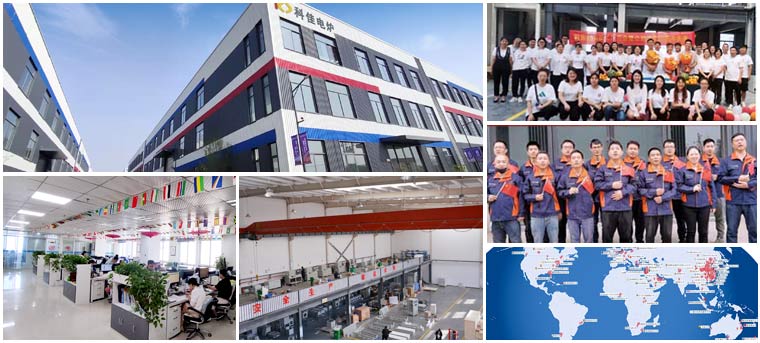
Zhengzhou KJ Technology Co., Ltd. is a high-tech enterprise specializing in the research, development and sales of heat treatment products. Our products cover muffle furnaces, tube furnaces, vacuum furnaces, atmosphere furnaces, CVD/PECVD systems, dental furnaces, bell type furnaces , trolley furnaces, etc., which are widely used in metallurgy, vacuum brazing, ceramic sintering, battery materials, metal processing , parts annealing, additive manufacturing, semiconductors, scientific intelligent instrumentation, aerospace and industrial automatic control systems and other different fields.
Please feel free to contact us.
WhatsApp: +86 18037178440
Email: web@kejiafurnace.com
 English
 简体中文
简体中文 Русский язык
 Français
 日本語
日本語 한국어
한국어 Português
 Español
 Website navigation
 Position:








 Send E-mail:web@kejiafurnace.com
 Wechat/Whatsapp: +86 18037178440
 Company Tell: +(86)18037178440







 E-mail:web@kejiafurnace.com
 Tell:+(86) 18037178440
 Whatapp:+(86) 180-3717-8440
 Address:Room 1505, Building 9, No. 26 Dongqing Street, Zhengzhou High-tech Industrial Development Zone