USA Materials Science Lab | KJ-TX1000 Continuous Rotary Tube Furnace
1. Core DemandThe customer is USA Materials Science Lab, focusing on small-batch, continuous high-temperature calcination experiments for new energy powder materials (catalyst precursors/ceramic powders). The core pain points include:High requirements for temperature and uniformity: Stable achievement of 1000°C design temperature and 900°C long-term working temperature is required. Uneven heating of powders leads to performance deviations between batches, which fails to meet the reproducibility of scientific research data.
Continuous processing and sealing requirements: Continuous feeding and discharging under inert atmosphere protection is needed to avoid oxidation of powders in contact with air. Meanwhile, it needs to be compatible with the laboratory vacuum feeding system to realize closed material transmission.
Data traceability and operational convenience: The experimental process must be recordable and traceable, requiring the equipment to have a data export function. The operation interface needs to adapt to the experimental workflow of researchers to reduce the risk of misoperation.
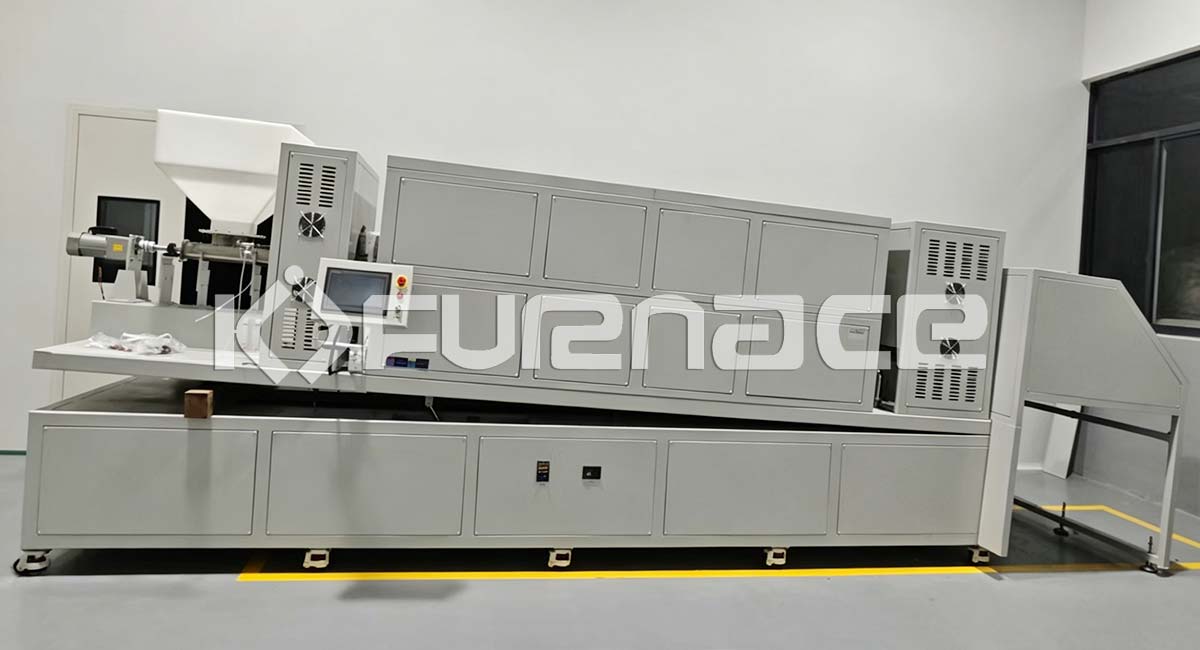
2. Customized SolutionBased on the customer's scientific research scenario requirements, we customized the KJ-TX1000-S400CK4W Continuous Rotary Tube Furnace for them, with key configurations and optimizations as follows:
Precise temperature control and uniform heating design:
Adopting an alumina fiber furnace chamber with four independent temperature zones (500mm × 4 sections, heating zone length 2000mm), paired with silicon carbide heating elements and 4 N-type thermocouples. The heating rate is adjustable from 0-10°C/min, ensuring uniform temperature field in the furnace. The powder is heated without dead angles during rotation, completely solving the batch deviation problem.
Adaptation to continuous closed processes:
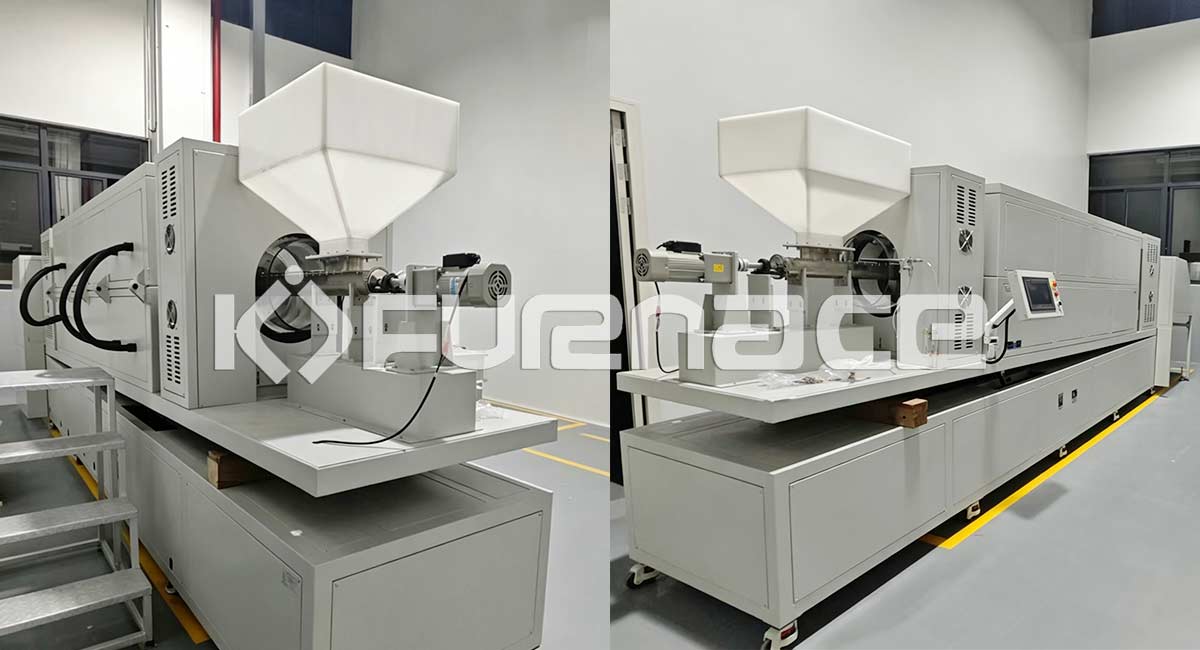
Equipped with a quartz tube furnace (Φ400×4500mm) and a material baffle sealing structure at the feed end, continuous calcination under inert atmosphere protection can be realized. The feed hopper is made of PP material (120L volume), the feed pipe is sprayed with zirconia, and the top cover is coated with PTFE. A 210mm standard interface is reserved to directly connect to the customer's vacuum feeder, realizing fully closed material transmission.
Research-friendly operation and data management:
Equipped with a touch screen control system and a USB data interface, it can record temperature curves and process parameters in real time and export data. The electric door opening design and segmented furnace layout take into account the convenience of experimental operation and equipment maintenance, fully adapting to the high-frequency and multi-batch scientific research experimental needs of the laboratory.3. Customer Feedback"The equipment runs stably and reliably, perfectly solving the problems of uneven heating and poor batch consistency during our powder calcination process. Under continuous working conditions at 900°C, the furnace temperature control accuracy far exceeds expectations, and the inert atmosphere sealing effect also meets the experimental requirements for easily oxidizable materials. The touch screen operation interface is intuitive and easy to use, and the data export function greatly facilitates our experimental data sorting and paper writing. From customized communication to equipment delivery, the technical team of Kejia Furnace responded throughout the process and quickly provided solutions for our vacuum feeding interface requirements. They are a trustworthy high-temperature furnace equipment supplier."
For inquiries and customized solutions,
contact us via WhatsApp: +86 18037178440
Email: web@kejiafurnace.com.
 English
 简体中文
简体中文 Русский язык
 Français
 日本語
日本語 한국어
한국어 Português
 Español
 Website navigation
 Position:









 Send E-mail:web@kejiafurnace.com
 Wechat/Whatsapp: +86 18037178440
 Company Tell: +(86)18037178440







 E-mail:web@kejiafurnace.com
 Tell:+(86) 18037178440
 Whatapp:+(86) 180-3717-8440
 Address:Room 1505, Building 9, No. 26 Dongqing Street, Zhengzhou High-tech Industrial Development Zone